
Learn how to grow strawberries at home — from choosing June-bearing, ever-bearing, and day-neutral types to planting at the correct depth, managing runners, renovation, and harvesting for the best flavor.
A sun-warmed strawberry picked directly from the garden and eaten immediately is one of summer’s most perfect experiences — and one of the most tangible demonstrations of why homegrown fruits bear no meaningful resemblance to what arrives in stores. Commercial strawberries are bred for shelf life, firmness, and appearance; home garden varieties are selected for flavor, and the difference is immediate and dramatic from the first bite.
Strawberries are also among the most productive fruit crops available to home gardeners with limited space. Penn State Extension notes that strawberries are the ideal fruit crop for gardeners with limited space — plants are low-growing perennials that provide a delicious supply of fruit and make an attractive groundcover when not fruiting. A well-managed strawberry bed can produce abundantly for 3 to 5 years before renovation or replacement, delivering fruit from June through fall depending on the varieties chosen.
At Outz News Garden, Maria Walker covers the complete strawberry growing guide — understanding the three main types, planting at the precise depth that determines success or failure, managing runners, the renovation process that extends bed productivity, harvesting at peak flavor, and protecting plants through winter. For more fruit-bearing plants in the home garden, see our blueberry growing guide.
The Three Types of Strawberries: Choosing the Right One
According to University of Minnesota Extension, there are three types of strawberries available to the home gardener, each with a distinct production pattern:
June-Bearing Strawberries — The Classic
June-bearing strawberries produce a single large, concentrated crop in mid-June to early July — the most prolific and flavorful strawberry harvest type. University of Minnesota Extension notes that June-bearing strawberries normally produce the largest yield per season, though in a short period of time. Penn State Extension’s strawberry growing guide confirms that the June-bearing strawberry is the most commonly grown type in Pennsylvania and throughout much of the US, the result of decades of breeding for productivity, size, and other attributes.
- Planting system: matted row — plants space 18 to 24 inches apart in rows 36 inches apart, with runners allowed to fill the row to 12 to 18 inches wide
- Productivity: most productive in years 2, 3, and 4 after planting; requires annual renovation after harvest to maintain vigor
- Best varieties: Earliglow (excellent flavor; early season), Allstar (large berries; midseason; disease resistant), Jewel (classic excellent-flavored midseason variety), Honeoye (vigorous; very early; excellent yield)
- Penn State Extension notes that early varieties may be more subject to frost injury because they bloom earlier, and the open blossom is the stage most susceptible to frost injury
Day-Neutral Strawberries — Continuous Production
Day-neutral strawberries produce fruit throughout most of the growing season in flushes from early summer through fall — a different experience from June-bearing’s concentrated harvest. University of Minnesota Extension specifies that day-neutral plants produce fruit throughout most of the growing season, and Penn State Extension notes that day-neutral varieties bear throughout the growing season and are highly productive and flavorful.
- Penn State Extension notes that day-neutral strawberries are not fond of very hot temperatures and may take a short break from fruiting in midsummer heat
- Management difference: runners must be removed from day-neutral plants since they take energy away from fruit production
- Best varieties: Albion (outstanding flavor; productive; excellent disease resistance), Seascape (dependable; good flavor; heat-tolerant), Tristar (very flavorful; slightly smaller berries)
- University of Maryland Extension notes day-neutral cultivars can be treated as annuals and replanted each year, or mulched and overwintered to produce a harvest for a second year before replacement
Ever-Bearing Strawberries — Two Crops
University of Minnesota Extension identifies ever-bearing types as producing two crops — one in early summer and the second in early fall. While the name suggests continuous fruiting, ever-bearing types actually produce two distinct flushes rather than the steady season-long production of day-neutral varieties. They are less widely grown than June-bearing or day-neutral types and have generally been superseded by improved day-neutral varieties for most home garden purposes.
Site Selection and Soil Preparation
Site Requirements
According to University of Maryland Extension’s strawberry guide, strawberries need 6 to 8 hours of full sun daily and well-drained, fertile soil with a pH of 5.8 to 6.5 for best production:
- Full sun — 6 to 8 hours minimum: light directly determines fruit quality and yield. Strawberries in partial shade produce fewer, smaller, less sweet berries with increased disease problems.
- Good air circulation: necessary to reduce fungal disease pressure on foliage and fruit. Avoid low-lying frost pockets and sites enclosed by walls or dense vegetation.
- Avoid frost pockets: strawberry blossoms are exquisitely sensitive to frost — University of Maryland Extension notes that strawberry foliage, crowns, and flowers are very vulnerable to damage during periods of temperature fluctuations in late winter to early spring. Plant on a gentle slope that allows cold air to drain away rather than accumulate around plants.
Crop Rotation — Critical
University of Minnesota Extension is specific: if possible, move strawberry plants to different areas of the garden every 3 to 4 years. Penn State Extension additionally specifies: wait at least three years before planting strawberries in fields where potatoes, tomatoes, peppers, or raspberries were grown previously, to reduce the chance of Verticillium wilt disease. Strawberries are susceptible to Verticillium wilt — a soil-borne fungus that persists for years and devastates new plantings.
Soil Preparation
Penn State Extension notes that the strawberry plant is in many ways unique — it is an herbaceous perennial whose shallow root system (in heavier soils, 90% of roots in the top 6 inches) makes it particularly sensitive to water deficit and excess. Prepare soil accordingly:
- Work 3 to 4 inches of compost into the top 8 to 10 inches before planting
- Ensure excellent drainage — raised beds are excellent for strawberries in heavy or poorly draining soils
- Test soil pH and adjust to 5.8 to 6.5 with sulfur (to lower pH) or lime (to raise pH) as needed. See our soil testing guide.
- Apply balanced fertilizer before planting
Planting Strawberries: Depth Is Everything
Like peonies, strawberry planting depth is a critical factor that determines success or failure. University of Maryland Extension provides an illustration of correct planting depth with specific guidance: the midpoint of the crown should be at soil level, with roots fanned out and spreading downward — not curled or crowded.
The Planting Depth Rule
- Crown at soil level: the growing point (crown) of the plant must sit exactly at the soil surface — not buried, not elevated
- Planted too deep (crown buried): crown rot; plant declines and dies
- Planted too shallow (roots exposed, crown above soil): plants dry out, heave in winter, and establish poorly
- University of Maryland Extension specifies: trim long roots to within 4 to 6 inches of the crown, and set plants with half the crown below the soil level with roots fanned out
Planting Steps
- Plant June-bearing varieties in spring as soon as soil can be worked — early April in most US regions
- Space June-bearing types 18 to 24 inches apart in rows 36 inches apart (for matted row system)
- Space day-neutral types 5 to 9 inches apart in all directions — they do not spread by runners
- Firm soil around roots to eliminate air pockets
- Water immediately and keep consistently moist for the first 2 to 3 weeks of establishment
- University of Maryland Extension recommends fertilizing plants lightly with a complete liquid or granular fertilizer at planting
Removing First-Year Flowers
One of the most counterintuitive strawberry growing recommendations — but one of the most important: University of Maryland Extension specifies that for June-bearers, remove the flowers for the entire first season to direct the plant’s resources into developing a large root system and healthy plant. University of Minnesota Extension confirms: removing flowers is a significant labor cost but is necessary during these time periods. Day-neutral plants need flower removal for the first 4 weeks after planting, then can be allowed to fruit.
The investment pays off dramatically: plants that were not allowed to fruit in their first year typically produce significantly more and larger fruit in years 2, 3, and 4 than those that fruited in their first season.
Managing Runners
Runners are horizontal stems that radiate from the base of strawberry plants and develop daughter plants at their tips — the strawberry plant’s vegetative propagation mechanism:
June-Bearing Runners
For June-bearing matted row systems, runners are encouraged to fill the 12 to 18 inch wide row band. University of Minnesota Extension specifies: let runners develop until the row is 1 to 1½ feet wide, then remove any runners that would exceed this width. Controlling the row width maintains plant density, fruit size, and air circulation within the planting.
Day-Neutral Runner Removal
Day-neutral strawberries are managed completely differently — University of Minnesota Extension states that runners must be removed from day-neutral strawberries since they serve no purpose in this system and take energy away from fruit production. Remove runners as they appear throughout the season.
Watering and Fertilizing
Watering
Penn State Extension identifies strawberry plants as shallow-rooted, with most root systems in the top 6 to 12 inches of soil — underscoring the need for consistent irrigation. University of Minnesota Extension specifies:
- Provide 1 inch of water per week throughout the growing season
- More frequent watering may be needed during hot, dry periods and on sandy soils
- Drip irrigation is preferred — water delivered at the soil level reduces foliage and fruit wetness that promotes gray mold and other fungal diseases
- University of Maryland Extension warns: remove weeds promptly — they encourage high populations of plant bugs, promote disease development by reducing air circulation (leaves stay wet longer), and compete strongly with shallow-rooted strawberry plants for nutrients and water
Fertilizing
University of Maryland Extension specifies a targeted fertilizing approach based on strawberry type: fertilize June-bearing plants after the harvest season (not before, as pre-harvest nitrogen reduces fruit quality), and day-neutral plants once a month from May through September. This timing reflects each type’s production pattern and nutrient demands.
Harvesting Strawberries at Peak Flavor
According to Penn State Extension’s strawberry guide, most field operations in strawberry production require careful attention to detail — and harvesting is no exception. University of Maryland Extension provides specific harvest guidance:
- Wait for full ripeness: strawberries should be left on the plant 1 to 2 days after turning fully red. Berries picked when not fully red will continue to change color but will not sweeten.
- Harvest in the morning: if possible, pick early in the day when berries are cool — they store longer when picked cool than when warm from afternoon sun
- Twist the stem: UMD specifies to twist the stem and fruit from the vine rather than pulling, which can damage the plant
- The harvest period for June-bearers is usually 3 weeks long but can vary due to spring weather conditions
- Refrigerate quickly — wash before eating, not before storage; berries can be refrigerated for 3 to 5 days
- Gray mold caution: UMN Extension warns that gray mold can spread rapidly even after harvest — handle berries with care and refrigerate soon after picking; keep diseased fruit separate from healthy fruit
Renovation: Extending Bed Life in June-Bearers
Annual renovation is what extends a June-bearing strawberry bed’s productivity from 1 to 2 years to 3 to 5 years. Penn State Extension specifies: the renovation process should begin immediately after the harvest is completed — this gives plants time to develop the canopy that will determine the number and quality of flower buds producing fruit the following spring.
Renovation steps (per Penn State Extension):
- Remove weeds; narrow the rows to 6 to 12 inches; thin plants so there is a plant about every 3 to 4 inches, selecting strong runner (daughter) plants and removing mother plants when 3 to 4 years old
- Clip or mow leaves off and fertilize the plants with about 5 pounds of 10-10-10 per 100 feet of row
- Irrigate if weather is exceptionally dry
- UMN Extension specifies: straw mulch is important in spring and summer to reduce fruit and flower diseases by covering soil and reducing spore movement carried by raindrop splash
- With proper renovation and pest control each year, Penn State Extension confirms a strawberry planting should produce abundant large berries for at least 5 years
Winter Protection
University of Maryland Extension notes that shallow roots make strawberry plants prone to being pushed out of the soil (heaving) with winter freezes and thaws. University of Minnesota Extension specifies: straw mulch reduces winter injury and plants that have less winter injury have reduced disease. Practical winter protection:
- Apply 3 to 4 inches of straw mulch over the entire planting after plants have hardened off in fall — typically when temperatures consistently reach the low 20s°F
- Remove straw in spring when new growth is emerging and temperatures are consistently above freezing — UMN specifies leaving ½ to 1 inch of straw between rows as mulch to keep fruit off the soil and reduce weeds
- Watch for frost events during early spring flowering — cover plants with row cover or straw on nights when temperatures below 30°F are forecast; the open blossom is the stage most susceptible to frost
Quick-Reference Strawberry Growing Guide
- Choose your type: June-bearing for the largest concentrated harvest; day-neutral for season-long production
- Crown at soil level — the most critical planting detail
- Remove all flowers the first year (June-bearing) — first 4 weeks for day-neutral
- Full sun — 6 to 8 hours and excellent drainage
- 1 inch of water per week — consistent moisture for shallow roots
- Renovate June-bearers immediately after harvest each year
- Remove day-neutral runners throughout the season
- Mulch with straw for winter — prevents heaving and reduces disease
- Rotate every 3 to 4 years — never where tomatoes/potatoes/peppers/raspberries grew
Learning how to grow strawberries at home produces a harvest whose quality has no commercial equivalent — berries picked at true peak ripeness, still warm from the sun, eaten within minutes of harvest. The investment in correct planting depth, first-year flower removal, consistent moisture, and annual renovation pays dividends in years of abundant, flavorful fruit from a small and manageable garden space.
Start with a small June-bearing planting — 20 to 25 plants in a 4-foot-wide raised bed provides a meaningful first-year harvest and a foundation for expanding in subsequent seasons. Patience through that first flower-removing season is genuinely rewarded by the production that follows.
Share your strawberry harvest photos and favorite variety recommendations in the comments — we especially love seeing those first-season runner management setups! And for more fruit growing in the home garden, see our blueberry guide and our raised bed gardening guide.
👉 Read Next: Vegetable Garden for Beginners — The Complete Step-by-Step Guide
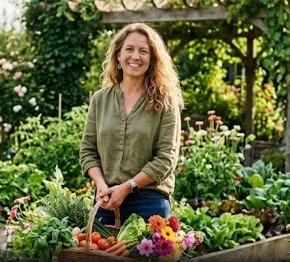
Maria Walker is a certified horticulturist and gardening specialist with over 15 years of hands-on experience in plant care, garden design, and sustainable growing practices.
She holds a Bachelor’s degree in Horticulture Science and a Master’s degree in Sustainable Agriculture — and has spent her career helping people of all skill levels create beautiful, thriving gardens.
Maria launched Outz News Garden with one simple mission: to make gardening accessible and inspiring for everyone, from first-time planters to seasoned green thumbs.